DIY can be a sensible way to look after your home, but electrical work has a clear legal boundary in NSW. There are useful jobs homeowners can safely handle themselves, from changing a light globe to testing a safety switch, but work on the fixed wiring and electrical installation must be carried out by, or under the supervision of, someone appropriately licensed.
The distinction is not really about whether a job looks easy. Replacing a light switch or installing a new ceiling fan might appear straightforward in an online video, but both involve the fixed electrical installation. In NSW, electrical wiring work requires an electrical licence or certificate regardless of the value of the job.
What counts as electrical wiring work in NSW?
NSW defines electrical wiring work broadly. It includes installing, repairing, altering, removing or adding to an electrical installation. An electrical installation includes the fixed wiring, fittings, meters, apparatus and fixed appliances associated with supplying and using electricity in a property.
For a homeowner, the practical rule is simple: if the job requires you to open, alter, disconnect or add to the fixed 230-volt wiring of the home, it is not a DIY job.
That means work such as replacing a power point, changing a wall switch, installing a new light fitting, adding a circuit, altering wiring or replacing a hard-wired appliance generally needs a licensed electrician.
A useful rule of thumb: changing something that is designed for the homeowner to change, such as a light globe or removable battery, is very different from opening a fitting and working on the wiring behind it.
Electrical tasks you can usually do yourself
There are still plenty of basic electrical safety and maintenance tasks that do not involve altering the wiring.
Change a light globe
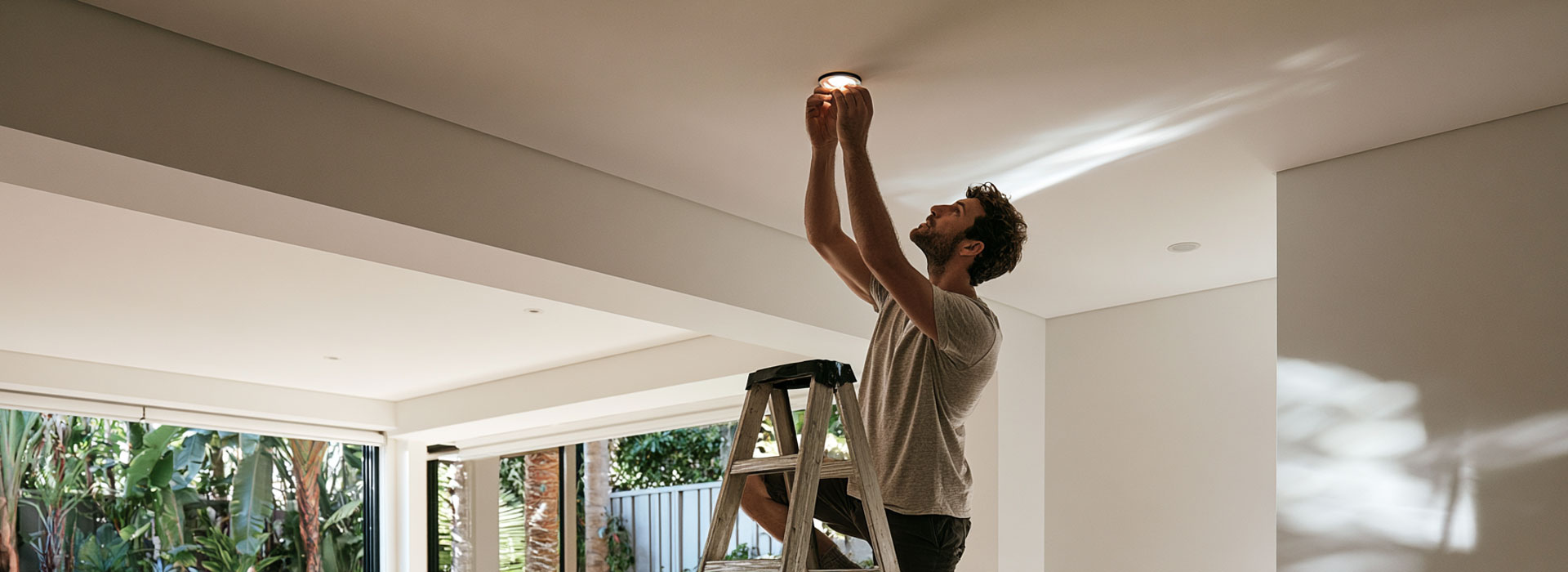
NSW Government guidance specifically identifies changing a light globe as ordinary maintenance a homeowner can carry out. Make sure the light is switched off, allow the old globe to cool and use a suitable replacement of the correct type and rating. If the fitting itself is loose, damaged, scorched or not working properly, that moves beyond a globe change and should be assessed by an electrician. See our Lighting Installation service for help with fittings, new lighting or lighting faults.
Test your safety switches
Homeowners can and should test their safety switches using the Test or T button. NSW Government guidance recommends doing this twice a year. Pressing the test button should cause the switch to trip and cut power to the protected circuit. You can then reset it.
If a safety switch does not trip when tested, will not reset, or repeatedly switches off without an obvious reason, do not try to repair or replace it yourself. An electrician can investigate the cause and check whether the home has appropriate protection. You can read more about Safety Switches and how they protect different circuits in the home.
Reset a tripped breaker or safety switch
Resetting a breaker or safety switch is not the same as repairing it. If a circuit trips once, you may be able to switch off or unplug appliances on that circuit and reset the device. If it trips again, keeps happening, or there are signs such as burning smells, heat, buzzing or damaged equipment, leave it off and arrange Electrical Repairs or fault finding.
A breaker that repeatedly trips is doing its job by responding to a problem. Continually resetting it without finding the cause is not a solution.
Test and maintain smoke alarms
You can test smoke alarms using their test button and, where the alarm is designed for it, replace removable batteries in accordance with the manufacturer's instructions. Battery-powered smoke alarms can also be maintained without altering the home's electrical wiring.
A hard-wired smoke alarm is different because it is connected to the home's 230-volt electrical system. Installing or replacing a hard-wired alarm requires a licensed electrician. If you are unsure what type you have, or an alarm is faulty or due for replacement, see our Smoke Alarms service.
Jobs that need a licensed electrician
Some of the most common "small" jobs around a home are still electrical wiring work. These include installing, replacing or moving power points; installing or replacing switches; replacing fixed light fittings; adding new lights or circuits; installing or replacing ceiling fans; altering wiring during a renovation; and working inside a switchboard.
The same principle applies when a new appliance requires a fixed connection rather than simply plugging into an existing socket. If installation involves the property's fixed wiring, it should be handled by an appropriately licensed electrician.
For example, you can assemble or clean parts of a ceiling fan in accordance with the manufacturer's instructions where no electrical connection is involved, but the electrical installation or replacement of the fan itself is not DIY work. See Ceiling Fans for more information.
If you need to remove a power point, switch, light fitting or cover to reach fixed wiring, stop there. Even when the power appears to be off, the work may involve risks that are not obvious without the right testing equipment and training.
What about plug-in appliances?
NSW's definition of an electrical installation generally excludes an electrical article connected to and extending beyond a power point. That does not mean every repair to a plug-in appliance is automatically a good DIY project. Mains-powered appliances can contain hazardous components, stored electrical energy and faults that are difficult to identify safely.
For most homeowners, sensible DIY means using appliances as intended, checking cords and plugs for visible damage, keeping equipment clean and dry, and stopping use if something looks or behaves abnormally. If an appliance needs to be opened or electrically repaired, use a suitably qualified repairer rather than treating it as ordinary home maintenance.
Why does licensed electrical work need testing and certification?
Electrical work is not complete simply because a light turns on or a new power point appears to work. Licensed electrical work has to be tested to confirm that the installation meets the applicable safety requirements.
In NSW, electricians are required to submit a Certificate of Compliance for Electrical Work, known as a CCEW, for electrical wiring work. This provides a record that the work has been tested and is an important part of the compliance process.
When should you stop and call an electrician?
If you are unsure whether a task involves fixed wiring, it is better to check before taking anything apart. You should also arrange professional help if you find damaged wiring, a loose or scorched power point, repeated tripping, buzzing switches, burning smells, unexplained power loss or anything that gives an electric shock or tingling sensation.
These situations call for investigation rather than DIY experimentation. A licensed electrician can identify whether the problem is with an appliance, a circuit, a fitting, the switchboard or another part of the installation.
A practical boundary for DIY electrical work
You do not need an electrician for every interaction with electricity in your home. Changing a globe, testing a safety switch, checking a smoke alarm or resetting a tripped breaker are normal homeowner tasks when they can be done safely and without altering the wiring.
The boundary is reached when the job becomes electrical wiring work. If you need a power point moved, a light fitting replaced, a ceiling fan installed, a hard-wired smoke alarm changed or a fault investigated, that is the point to bring in a licensed electrician.
If you are not sure which side of that boundary your job falls on, speak with the i-ELEC team. We can help you work out whether you need an electrician and what the next practical step should be.